BIOGRAPHICAL SERIES · INDEPENDENT EDITORIAL
The Promise at Eighteen
Share this article
For Instagram, TikTok and other apps, use More apps where supported, or copy the link and paste it into your post or message.
On her eighteenth birthday, Princess Leonor made the constitutional oath required of Spain’s heir before the Cortes Generales.
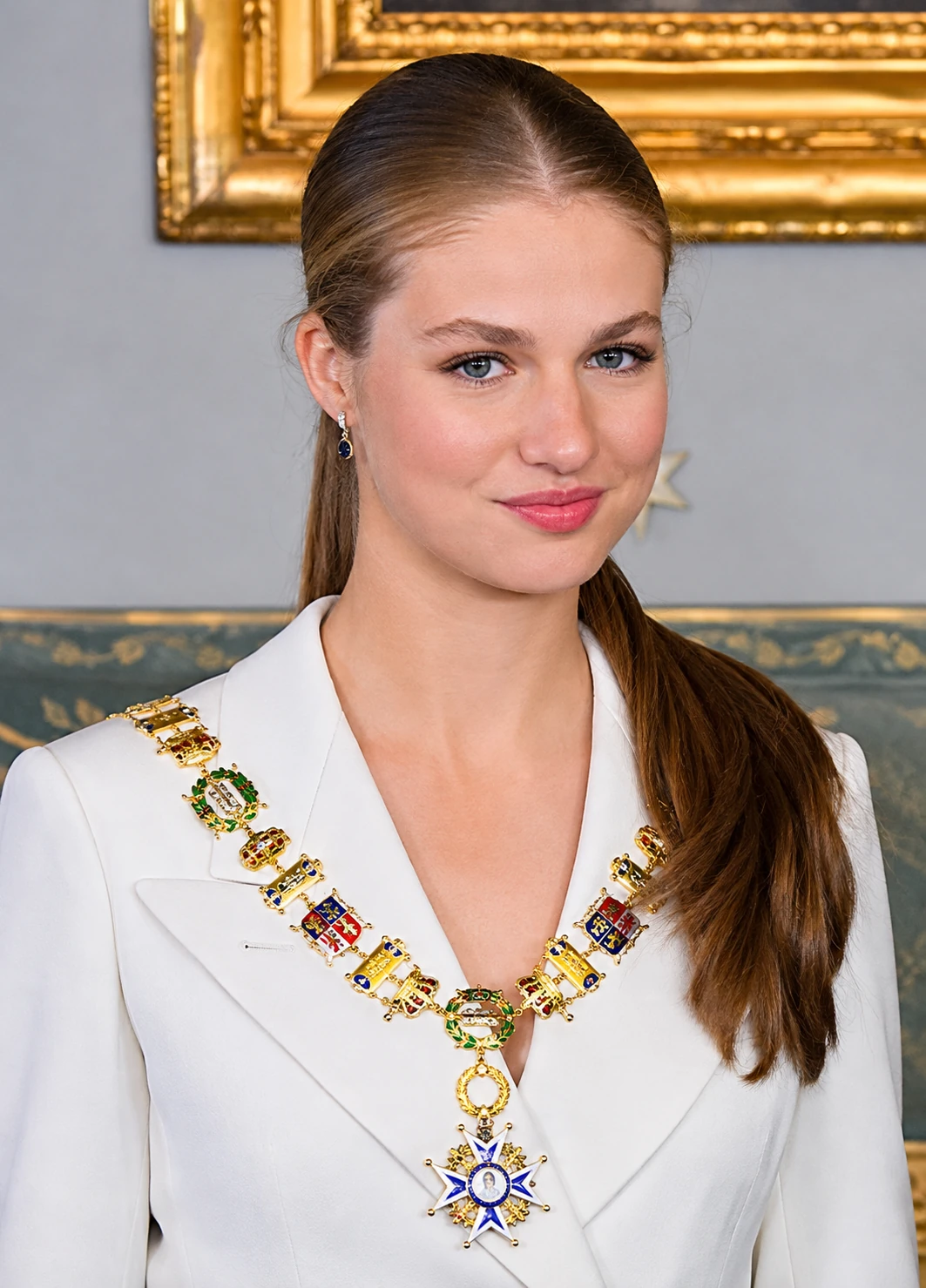
On 31 October 2023, Princess Leonor turned eighteen and took the heir’s constitutional oath before the Cortes Generales, Spain’s parliament. Her younger sister, Infanta Sofía, attended the ceremony but did not take that oath. Their father, Felipe VI, was the reigning King; Leonor’s promise marked her coming of age as his heir, not a change of monarch.
The distinction matters because Leonor had held her place in the succession since 19 June 2014, when Felipe was proclaimed King. The oath came more than nine years later, at the age specified by the Constitution. It joined a personal milestone to a public obligation: respect for the constitutional order and loyalty to the monarch.
An eighteenth birthday with a constitutional duty
Leonor was born in Madrid on 31 October 2005, the eldest daughter of Felipe and Letizia. By her eighteenth birthday, she was already Princess of Asturias, the title associated with the Spanish heir. Her birthday ceremony did not create that position; she had acquired it in 2014, when her father became King. What changed in 2023 was that she reached the age for the heir’s oath.
Spain’s Constitution links the title of Princess or Prince of Asturias, along with other traditional titles of the heir, to birth or to the event that makes someone heir. Leonor’s official biography also identifies her with the historic titles of Girona and Viana. These titles describe her position in the succession, while the oath expresses duties attached to that position.
A promise before the Cortes
The ceremony took place before the Cortes Generales, the Spanish parliament. That setting placed Leonor’s promise in an institution central to the country’s constitutional system, rather than treating her birthday as only a family occasion. Parliament’s role in the oath also makes the event distinct from her earlier public appearances as Princess of Asturias.
Leonor had previously read a constitutional text in public on 31 October 2018, her thirteenth birthday. Five years later, she addressed a different constitutional requirement: the oath of the heir on reaching adulthood. Reading a text and taking an oath are different acts. One presents words to an audience; the other is a formal promise made under the Constitution.
What Article 61 requires
Article 61 of the Spanish Constitution sets out separate oaths for a monarch at proclamation and for the heir on coming of age. Both concern the Constitution, the laws and the rights of citizens and Spain’s autonomous communities. The heir’s oath adds loyalty to the monarch. Leonor therefore took the oath appropriate to her existing status, not the oath of a newly proclaimed sovereign.
The distinction reflects how Spain’s constitutional monarchy distributes authority. Article 56 identifies the monarch as head of state and assigns the Crown the highest international representation of the Spanish state, a role distinct from day-to-day government. Article 64 provides for royal acts to be countersigned, with responsibility resting on the countersigning authority. Leonor’s oath did not transfer those functions from Felipe.
A constitutional pattern
Article 61 provides a coming-of-age oath for the heir; it was not written solely for Leonor. On 31 October 2023, father and daughter occupied different constitutional positions: Felipe was King, while Leonor was his heir. Her promise included loyalty to the monarch, an element that distinguishes the heir’s oath from the oath prescribed for a sovereign at proclamation.
Their paths also connect through military education. In its March 2023 announcement of Leonor’s training, Casa Real compared the planned structure across three services with Felipe’s training. The announcement linked her programme to future representational responsibilities. That institutional comparison helps explain why military education followed alongside her constitutional role, without making the oath itself a military appointment.
Sofía’s place at the ceremony
Infanta Sofía attended her sister’s oath on 31 October 2023 but did not take the heir’s oath. Born on 29 April 2007, she is the younger daughter of Felipe and Letizia. The difference between the sisters at the ceremony was not simply their ages: the promise Leonor made was the one Article 61 assigns to the heir.
The sisters had appeared together in an earlier public activity, reading Don Quixote on 23 April 2020. That shared reading and Sofía’s attendance at the oath show different kinds of participation alongside Leonor. Neither required Sofía to make the heir’s constitutional promise. Her absence from the oath itself should not be confused with a statement about her place in the succession.
Study and service after the oath
Before the ceremony, a March 2023 plan had set out Leonor’s military education: the Army academy at Zaragoza in 2023–24, Navy training at Marín and aboard Juan Sebastián de Elcano in 2024–25, and the Air and Space academy at San Javier in 2025–26. Those were announced stages. Later official records separately document an Army milestone in July 2024 and her embarkation at Cádiz in January 2025.
Her education continued beyond military training. A 2026 announcement described a four-year Political Science programme at Carlos III University of Madrid’s Getafe campus; her official biography records her arrival on 7 September. Its subjects include law, economics, history and international relations. The next episode turns back to the military plan and asks why a princess trains as a soldier.
A question to take with you
Did Leonor become Queen when she took the oath?
Reveal the answer
No. She took the constitutional oath required of the heir on reaching adulthood. Felipe VI remained King.
Reading progress is saved only in this browser. It is not linked to your account.
Sources and further reading
- Casa Real · Official biography
- Casa Real · Education in Wales
- Casa Real · Military education plan
- Casa Real · Constitutional oath
- Casa Real · Official profile and speeches
- Casa Real · Aviation education
- Casa Real · University education announcement
- Casa Real · First solo activity: Instituto Cervantes
- Casa Real · Princess of Asturias Awards 2019
- Casa Real · Constitutional roles and succession
- Casa Real · Graduation at UWC Atlantic College
- Casa Real · Felipe VI: official biography
- Casa Real · Sofía: education in Wales
Editorial sources checked: