BIOGRAPHICAL SERIES · INDEPENDENT EDITORIAL
Who Is Princess Leonor?
Share this article
For Instagram, TikTok and other apps, use More apps where supported, or copy the link and paste it into your post or message.
She was eight when her place in Spain’s history changed. Behind the title is a journey through classrooms, public promises and the long preparation for a life of service.
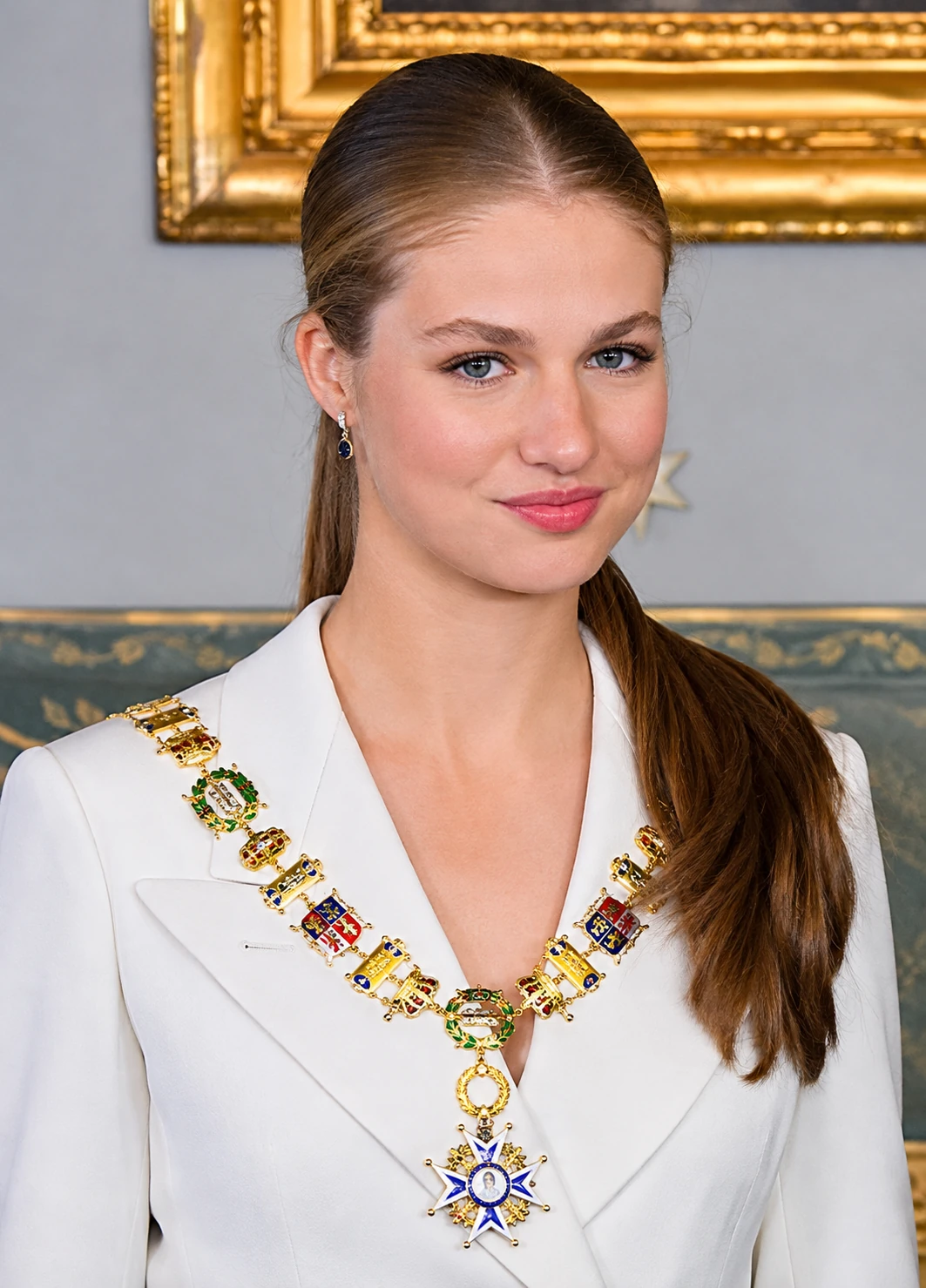
On 19 June 2014, an eight-year-old girl became heir to Spain’s Crown. There was no examination she could prepare for, no application to complete, and no campaign to win. Her father became King Felipe VI, and Leonor’s place in the royal family changed with him. The new title arrived on a single day. Learning what it would ask of her would take years.
That is where her story becomes more interesting than a collection of royal photographs. How does a child grow into a public responsibility that exists long before she can fully understand it? Leonor’s documented journey offers a succession of answers: a first appearance at an important ceremony, a school far from Madrid, a promise before Parliament, and an education that would move between military academies. Each was a different kind of preparation.
Before the title, a daughter and a sister
Leonor de Borbón y Ortiz was born in Madrid on 31 October 2005, the elder daughter of Felipe and Letizia. Her younger sister is Infanta Sofía. Those familiar family names can make the story sound straightforward. Yet the same person can be a daughter in a family photograph, a pupil in a classroom and the heir at a state ceremony. The setting determines which part of the story we are seeing.
There is also an important boundary. The public record can establish where a ceremony took place and what Leonor did there. It cannot tell us what a family said behind closed doors or what she privately felt at the time. Her journey does not need an invented secret to be compelling. Its central question is already unusual enough: what does preparing to inherit a public role actually involve?
Eight years old, with a different future
When Felipe VI became King in June 2014, Leonor became Princess of Asturias. Casa Real also lists the titles Princess of Girona and Princess of Viana, names connected to different historical traditions within Spain. To a reader encountering them for the first time, the titles can sound like decorations. In the biography, however, they mark her position as heir. We will unpack their history in a later chapter.
It is tempting to jump straight from a childhood photograph to an image of a possible future reign. Doing so skips the most revealing part of the story: the years in between. A title can be inherited instantly. Experience cannot. That gap between a position already held and responsibilities still being prepared for is the thread running through this series.
From being seen to being heard
In October 2019, the Princess of Asturias Awards brought Leonor to Oviedo’s Teatro Campoamor. The official account records her intervention at a ceremony celebrating achievements across culture, science, sport and other fields. She was still thirteen. For someone who first knew her through family appearances, this offered a different image: Leonor taking a speaking part at an event bearing the title she carried.
Another milestone followed at the Instituto Cervantes in Madrid on 24 March 2021. Casa Real describes it as her first solo activity. She deposited two books in the Caja de las Letras: the Constitution she had read from in 2018 and the edition of Don Quixote she had read with Sofía in 2020. The objects gave the ceremony a small narrative of its own, linking earlier public readings with a new occasion led by Leonor.
The classroom beyond Spain
A month before that Cervantes event, Casa Real had announced another change of setting. Leonor would study the International Baccalaureate at UWC Atlantic in Wales for the 2021–2022 and 2022–2023 academic years. The announced programme included sciences and humanities, research, a course on knowledge, and activities involving creativity, physical effort and community service. It was a school programme rather than a royal ceremony.
The importance lies in the change of scale. In Spain’s royal story, Leonor occupied a highly specific position. In the educational framework described by UWC and the official announcement, she was one student undertaking a shared programme. Those are not contradictory identities. Together, they help explain why a biography of an heir must follow classrooms as closely as ceremonies.
A birthday with a public promise
The next major turning point brought the story back to Madrid. On 31 October 2023, her eighteenth birthday, Leonor swore the Spanish Constitution before the Cortes Generales at the Congress of Deputies. Her parents and Sofía were present. The official record places her at the centre of a formal institutional act, no longer simply attending an occasion with the family.
Later that day, the programme continued at Madrid’s Royal Palace, where Felipe VI presented her with the Collar of the Order of Charles III. One day could contain several ceremonies, each with its own purpose. Taken together, they made a memorable public milestone. They did not bring the story of preparation to an end. In another part of her life, a demanding new educational sequence had already begun.
A title is inherited. Preparation takes time.
In March 2023, Casa Real had announced a military education moving through the Army, Navy and Air and Space Force. The plan began with the General Military Academy in Zaragoza and continued through naval and aviation education. Its stated purpose linked that training to her future responsibilities. The academy, the training ship and the aviation setting would provide very different chapters from a theatre stage or the chamber of Parliament.
There is no need to predict a date for a future reign to see the shape of the story so far. It is a sequence of roles becoming more visible and preparation becoming more varied. The next chapter begins before Wales, before the academies and before the oath: with the morning her father became King, when Leonor was eight and the title Princess of Asturias became hers. What changed that day—and what did not?
A question to take with you
Did Leonor become Queen in 2014?
Reveal the answer
No. She became heir when Felipe VI became King.
Reading progress is saved only in this browser. It is not linked to your account.
Sources and further reading
- Casa Real · Official biography
- Casa Real · Princess of Asturias Awards 2019
- Casa Real · First solo activity: Instituto Cervantes
- Casa Real · Education in Wales
- Casa Real · Military education plan
- Casa Real · Constitutional oath
Editorial sources checked: